
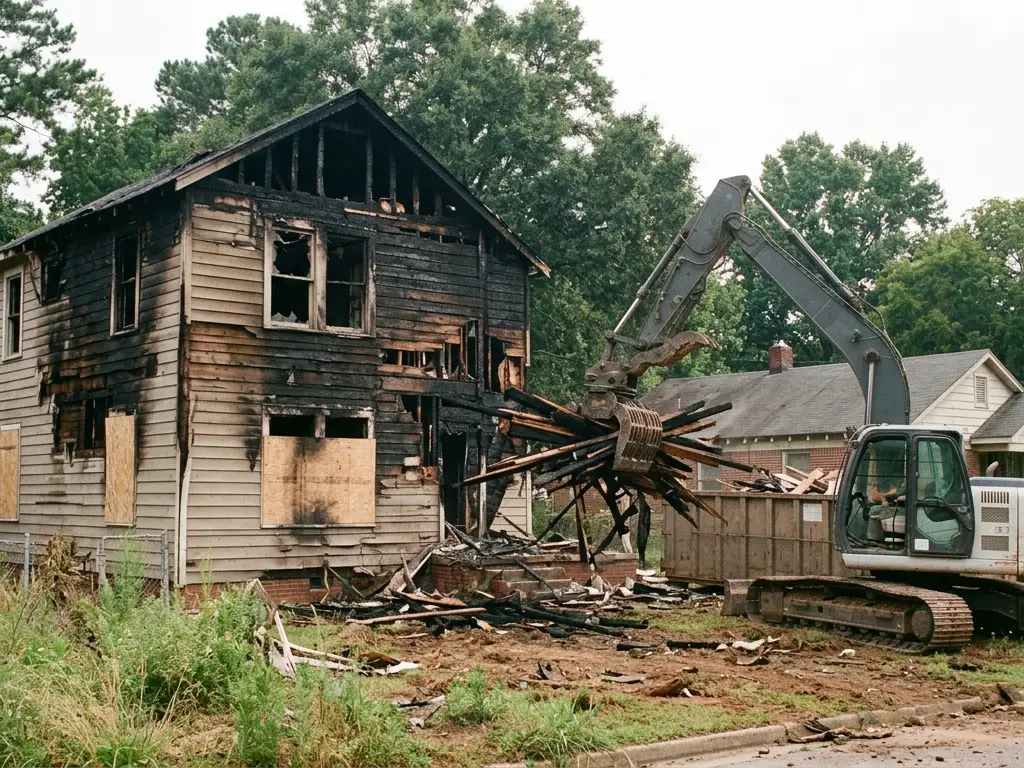
After a house fire
Demolition Little Rock: Fire Damaged House Demolition in Little Rock
A burned house taken down safely, the charred debris hauled to a permitted landfill, and the lot cleared, on a timeline that fits the insurance claim and any notice from the City.
- Little Rock and 12 nearby towns
- Written price before work starts
- Permit and utility steps explained
- Houses, pools, garages and slabs
- Lots left level and swept
Demolition Little Rock arranges demolition of fire-damaged houses in Little Rock and the nearby towns, for owners, heirs, insurers and buyers dealing with what is left after a fire. A burned structure is less stable than it looks, often attracts trespassers, and in Little Rock fire damage is one of the conditions Code Enforcement inspects for under the Minimum Housing Code.
Taking down a burned house on your own schedule is often $4,000 to $15,000; left standing, it can be condemned, and Arkansas cities can recover the cost of a demolition they contract as a lien on the property, so you pay anyway and lose control of the price.
Describe the building, its size and what it is made of, and hear a typical price range before anyone drives out.
Call (501) 222-3828Signs a burned house cannot be saved
- Roof framing burned through or collapsed into the attic
- Charred floor joists, rim joists or wall studs in the main structure
- Walls out of plumb after the fire and the water used to fight it
- Smoke and soot through every room, with mold starting after the soak
- An insurer or engineer calling it a total loss
Insurance, adjusters and timing
Most fire demolitions are paid at least in part by a homeowner's policy. Before anything is torn down, the adjuster needs to finish the inspection and document the loss, and if the fire cause is under investigation, the fire marshal or investigator must release the scene. Demolishing too early can complicate a claim. Ask your adjuster for a written go-ahead and give the contractor a copy.
Many policies carry a separate amount for debris removal. A written, itemized demolition quote helps the adjuster apply it correctly.
What makes fire demolition different
- Stability. Burned framing can fail without warning; the structure is taken down from outside with a machine, not walked through.
- Debris. Ash, charred wood and melted materials are loaded and hauled; some landfills want fire debris kept separate.
- Hazards. Fire can break up asbestos materials in older houses, so suspect debris is handled with care and the asbestos question is asked first.
- Neighbors. Water spray keeps ash and dust down, and debris is covered in the truck.
Describe the building, its size and what it is made of, and hear a typical price range before anyone drives out.
Call (501) 222-3828When the City is involved
In Little Rock, Code Enforcement investigates structures that have sustained fire damage. Houses declared unsafe go to the City Board of Directors for condemnation, and once condemned, the City's Housing and Neighborhood Programs awards demolition contracts if the owner does not act. Dealing with it yourself is almost always cheaper and faster than waiting for the City, and the condemned house demolition page covers that process.
Describe the building, its size and what it is made of, and hear a typical price range before anyone drives out.
Call (501) 222-3828After the debris is gone
Once the burned structure and debris are cleared, the foundation is either broken out or left for a rebuild, the sewer stub is sealed, and the lot is graded so it drains. Many owners rebuild on the same lot; others sell it cleared, which usually sells faster than a burned house. In Jacksonville and the other Pulaski County cities, the city's own building office handles the permit.
Questions people ask
How much does it cost to demolish a fire-damaged house in Little Rock?
Typically $4,000 to $15,000, about the same as an ordinary house. A fire-damaged 1,060 square foot Little Rock home was reported at $3,710.
What are the signs a burned house is a total loss?
Burned-through roof framing, charred floor or wall structure, walls out of plumb, and an insurer or engineer calling it a total loss.
When can I demolish after a house fire?
After the adjuster has documented the loss and any fire investigation has released the scene. Get that go-ahead in writing.
Does insurance pay for demolition after a fire?
Often at least partly. Many policies include a debris removal amount, and an itemized demolition quote helps the adjuster apply it.
What happens if I do nothing with a burned house?
In Little Rock it can be condemned, and the City can contract the demolition itself and place the cost on the property.
How long does a fire demolition take?
One to three days of machine work, after the claim, the permit and the utility seals are in place.
Have something that needs to come down?
A house, a garage, a pool or a slab. Call with the address and the size, and get a typical price range and the permit steps that apply to it.
Call (501) 222-3828