
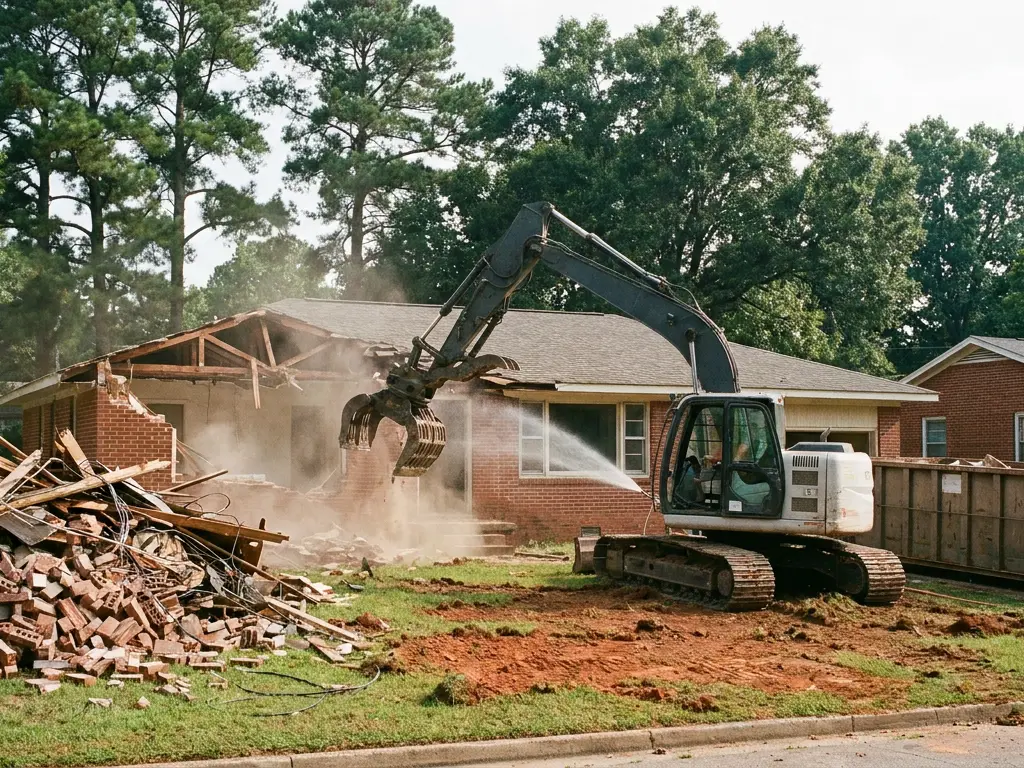
Whole-house teardowns
Demolition Little Rock: House Demolition in Little Rock
Brick ranches, frame bungalows and pier and beam houses taken down to the dirt, the debris hauled to a permitted landfill, and the lot graded so it drains.
- Little Rock and 12 nearby towns
- Written price before work starts
- Permit and utility steps explained
- Houses, pools, garages and slabs
- Lots left level and swept
Demolition Little Rock arranges complete house demolition in Little Rock: the permit, the utility disconnects, the teardown, the haul to a permitted landfill and the final grade. Most of the houses that come down here are 1950s to 1970s brick ranches and older frame houses that are cheaper to replace than to fix, plus the steady list of vacant and condemned houses the City and owners clear every year.
Removing the foundation and backfilling the footings adds roughly $1,000 to $3,000 to a teardown; leaving them in place can cost a buyer or builder $5,000 to $15,000 later when the new foundation hits old concrete.
Describe the building, its size and what it is made of, and hear a typical price range before anyone drives out.
Call (501) 222-3828Signs the house is a teardown, not a repair
Owners usually call after one of these:
- Foundation cracks or settling in several places, with doors and floors that no longer sit square
- Floor joists or sill plates rotted through on a pier and beam house
- A roof that has failed long enough to rot the framing underneath
- Fire or storm damage that reached the structure, not just the finishes
- A repair estimate over half the cost of building new
- A condemnation or unsafe-structure notice from the City
The order a Little Rock teardown runs in
- Survey and price. Square footage, construction (brick, frame or block), foundation type, basement, access for a 20-ton excavator and the distance to the landfill.
- Asbestos question. Older siding, floor tile, duct wrap and pipe insulation are checked. Commercial jobs need a survey or state notice before the permit.
- Utilities. Gas and power are cut at the street by the utilities, water is shut at the meter, and Little Rock Water Reclamation Authority seals the sewer line.
- Permit. The City permit is priced by square footage and reviewed by Planning for historic significance.
- Teardown. Usually one to two days of machine time, with water spray to keep dust down.
- Haul and grade. Debris goes to a Class 4 landfill; the foundation is broken out, holes are filled and compacted, and the lot is graded and seeded or strawed.
Most delays come from steps two and three, not from the excavator. A utility seal can take a week or more to schedule, so the best time to start that call is the day you decide.
What moves the price up or down
Construction and size
Frame houses come down faster and lighter than solid brick. A full basement or a two-story house adds volume and time, and a slab-on-grade house is cheaper to clear than one with a deep crawl space and block piers.
Hazardous materials
Asbestos abatement runs about $10 to $30 a square foot of affected material and must be finished before demolition. Lead paint changes how debris is handled, not usually whether the job happens.
Access and haul distance
A tight lot in the Heights or Hillcrest with overhead lines and mature oaks takes more care than an open lot in West Little Rock. Every round trip to the landfill on the south side of the city is time and fuel on the quote.
Describe the building, its size and what it is made of, and hear a typical price range before anyone drives out.
Call (501) 222-3828Little Rock rules that apply to a house teardown
The City's demolition permit checklist asks for a building permit application, a sewer seal before the permit is issued, a City business license and a $10,000 surety bond from whoever does the work, and a fee based on the building's square footage. Every application is screened for historic significance and conservation facade easements.
Inside the MacArthur Park Historic District, about 600 acres just south of downtown with roughly 275 structures built between 1842 and 1935, demolition needs a Certificate of Appropriateness from the Historic District Commission first. Near the State Capitol, the Capitol Zoning District Commission has the same say. Houses in North Little Rock and Sherwood go through their own city's building department instead.
Describe the building, its size and what it is made of, and hear a typical price range before anyone drives out.
Call (501) 222-3828After the house is gone
A cleared lot is only useful if it is level and drains. Clay soils across much of Pulaski County hold water in an open hole, so footing holes and basement cavities are filled in lifts and compacted rather than dumped full. If you plan to build again, say so at the start: a lot meant for a new foundation is finished differently from one meant for a yard. See teardown and rebuild for that version of the job.
Questions people ask
How much does it cost to tear down a house in Little Rock?
Most houses run $7,500 to $15,000, about $5 to $10 a square foot. Little Rock reports land around $4,000 to $14,000 for 1,000 to 2,000 square feet, more with a basement or asbestos.
What are the signs a house should be demolished?
Widespread foundation failure, rotted floor framing, long-term roof failure, structural fire or storm damage, or a repair bill over half the cost of new. A City condemnation notice decides it.
How long does it take to demolish a house?
One to three days of machine work for a typical house, after two to four weeks of permits, utility seals and any asbestos work.
Do I have to remove the foundation?
You do not have to, but a finished lot usually has the foundation broken out and the holes filled and compacted. Leaving old concrete in the ground causes trouble for the next foundation.
Who disconnects the utilities?
The utilities do. Gas and power are cut at the street, water at the meter, and the wastewater utility seals the sewer line before the City issues the permit.
Can I salvage anything before demolition?
Yes. Doors, fixtures, hardwood flooring, brick and metal can be pulled first. Salvage takes time, so it can lower or raise the price depending on what is worth taking.
Have something that needs to come down?
A house, a garage, a pool or a slab. Call with the address and the size, and get a typical price range and the permit steps that apply to it.
Call (501) 222-3828