
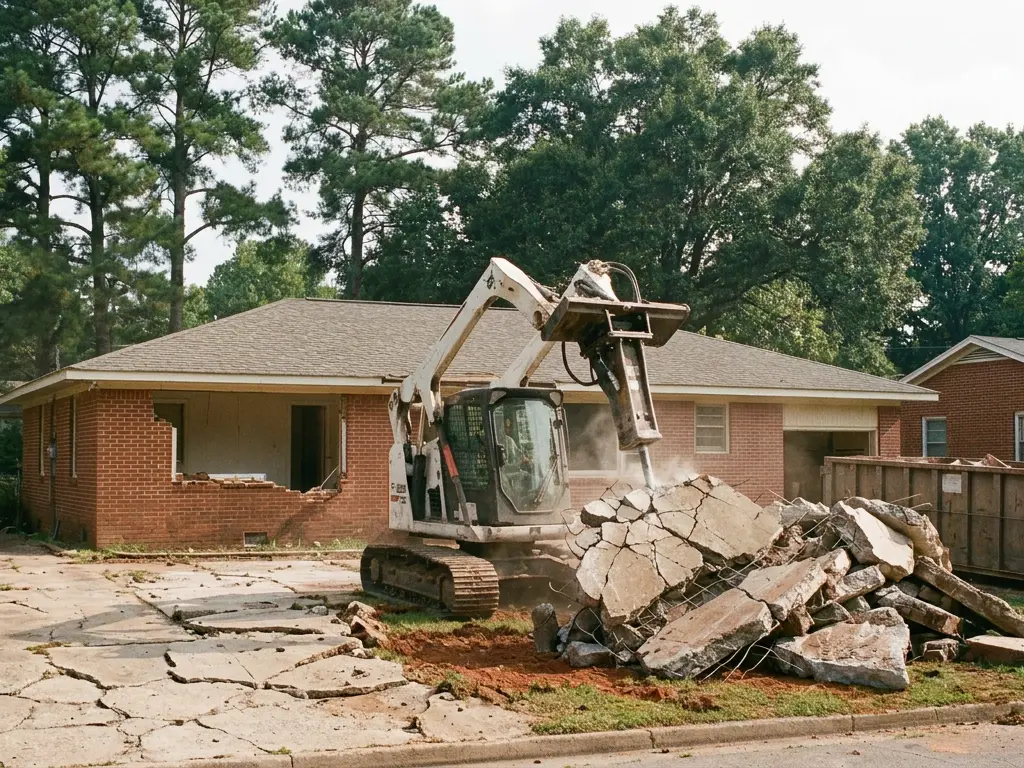
Slabs, footings, piers and crawl-space walls
Demolition Little Rock: Foundation Removal in Little Rock
The concrete a demolished building leaves in the ground, broken out down to the footings, hauled, and the holes filled and compacted so the next foundation sits on solid soil.
- Little Rock and 12 nearby towns
- Written price before work starts
- Permit and utility steps explained
- Houses, pools, garages and slabs
- Lots left level and swept
Demolition Little Rock arranges foundation and slab removal in Little Rock, usually as the second half of a house or garage demolition, sometimes on its own when an earlier teardown left the slab behind. Builders and buyers care about this part more than the demolition itself, because old concrete in the ground is the most common reason a new foundation costs more than planned.
Breaking out an old slab and its footings typically adds $1,000 to $3,000 to a teardown; a builder who finds buried footings after pouring has started can spend $5,000 to $20,000 on redesign and delay.
Describe the building, its size and what it is made of, and hear a typical price range before anyone drives out.
Call (501) 222-3828Signs the old foundation has to go
- A new house or addition is planned on the same footprint
- The slab is cracked through and heaved, not just surface-cracked
- A crawl space with crumbling block piers or brick curtain walls
- A basement left open after the house was removed
- A lender or buyer asking for a clear, buildable lot
Slab, crawl space and basement are different jobs
Slab on grade
The most common foundation in newer Little Rock subdivisions. The slab and its thickened edge footings are broken out with a hydraulic breaker, the rebar cut, and the concrete hauled. Plumbing lines cast in the slab come out with it.
Crawl space and pier and beam
Older houses in the Heights, Hillcrest and Capitol View often sit on brick or block piers with a curtain wall around the perimeter. Removing them means pulling every pier and footing, not just the wall you can see.
Basement
Less common here than further north, but some older Little Rock homes have them. Basement walls are broken down, the floor is broken through for drainage, and the cavity is filled in compacted lifts.
Backfill and compaction
Every hole left by a footing or a basement has to be filled in layers and compacted, or the ground settles under whatever is built next. Much of Little Rock sits on the well drained Carnasaw soils the USDA soil survey maps under the city, which compact well when they are not soaked. On shallow, stony ground like the Mountainburg soils under parts of North Little Rock, rock shows up close to the surface and the grade work changes.
Describe the building, its size and what it is made of, and hear a typical price range before anyone drives out.
Call (501) 222-3828Buried utilities and the sewer stub
Old service lines run through and under foundations. The sewer line is sealed at the property line before a Little Rock demolition permit is issued, gas is cut at the street, and water is capped at the meter. When the slab comes out, the old stubs are exposed, cut and capped again so nothing is left open under the new building.
Describe the building, its size and what it is made of, and hear a typical price range before anyone drives out.
Call (501) 222-3828Questions people ask
How much does foundation removal cost in Little Rock?
Typically $1,000 to $25,000. A small slab is at the low end; a basement or a heavily reinforced commercial slab is at the high end.
What are the signs the old foundation must be removed?
A new building on the same footprint, a slab cracked through and heaved, crumbling piers, or a buyer who needs a clear, buildable lot.
Can I build on top of an old slab?
Sometimes, but only if an engineer confirms it. Most builders prefer it removed, because they cannot see what is under it.
What happens to the holes after the footings come out?
They are filled in layers and compacted so the soil supports the next foundation without settling.
Do I need a permit to remove a foundation?
It is usually covered by the demolition permit for the building. Removing a slab on its own may need its own permit; ask the building office.
How long does slab removal take?
One to two days for most house slabs, longer for a basement.
Have something that needs to come down?
A house, a garage, a pool or a slab. Call with the address and the size, and get a typical price range and the permit steps that apply to it.
Call (501) 222-3828